The kitchen has always been where civilizations trade secrets. India’s food story is one of the most layered in Asia, built on centuries of trade, migration, invasion, and quiet daily ritual. Long before food trends existed, Indian cooks were doing something that connected them to kitchens across an entire continent. They were using the same spices, applying the same preservation methods, and gathering around food with the same communal spirit that defines Asian hospitality from Kolkata to Kyoto.
At a Glance
- Indian spices helped shape flavor profiles across East, Southeast, and Central Asia
- Fermentation techniques in Indian cooking run parallel to Korean, Japanese, and Chinese traditions
- India has one of the world’s most developed plant-based culinary systems
- Communal cooking rituals reflect shared values across the Asian continent
- The diaspora continues to carry and adapt these traditions in kitchens worldwide
The Spice Routes That Shaped a Continent
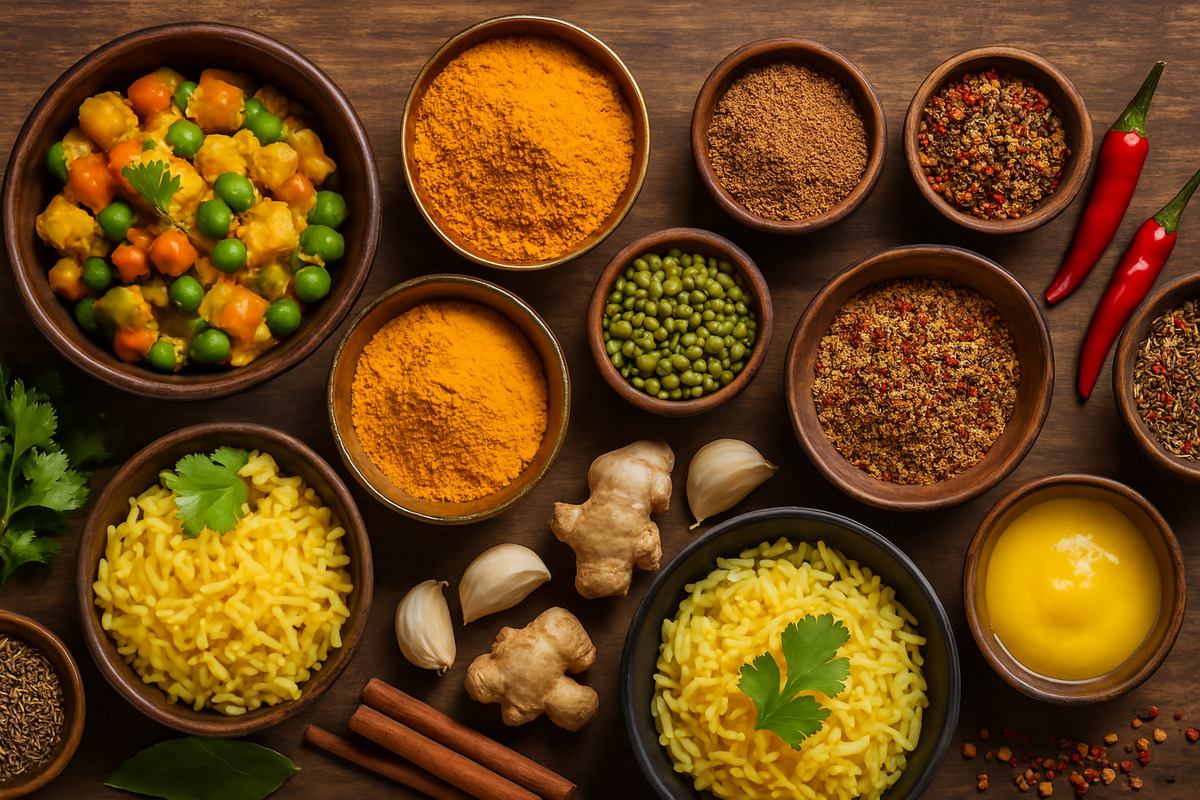
Before borders existed on maps, spices moved freely. Black pepper from the Malabar Coast. Cardamom from the Western Ghats. Cinnamon from Sri Lanka. These ingredients did not stay put. They traveled north into Central Asia, east into China, southeast into the Indonesian archipelago, and in doing so shaped how dozens of cultures learned to cook.
The fingerprints of Indian spice use are visible all across Asia. Chinese five-spice powder shares building blocks with Indian garam masala. The warming depth of cloves appears in both Indonesian rendang and a North Indian biryani. Star anise, used liberally in Vietnamese pho and Sichuan cooking, also appears in certain Indian curries and chai blends.
This is not coincidence. It is the result of thousands of years of trade. The ancient Silk Road was not just a corridor for silk. It was a channel for seeds, spice packets, and culinary ideas. Indian spice merchants were key players in that network, and their influence on Asian food culture is still tasted in kitchens from Mumbai to Manila.
What is remarkable is how each culture absorbed these shared ingredients and made them entirely their own. The turmeric that gives Indian dal its color also appears in Japanese golden milk, in Korean rice dishes, and in Thai curry pastes. The ingredient is the same. The expression is entirely different.
Fermentation as a Shared Language
Look closely at any traditional Asian food culture and you will find fermentation at its core. In India, fermented foods are not a trend or a health craze. They are ancient, practical, and rooted in deep knowledge about food preservation and digestion.
The dosa and idli batter, made from fermented rice and urad dal, relies on a process very similar to what Korean cooks use when preparing kimchi, or what Japanese cooks use in miso preparation. The souring and bubbling of natural fermentation creates both flavor and nutrition, and that logic is consistent across the continent.
Indian achaar, the sharp, oil-preserved pickle made with mango, lime, or mixed vegetables, mirrors Japanese tsukemono and Korean banchan in its purpose. Each of these traditions developed independently but converged on the same principle: preserve the harvest, feed the gut, layer the flavor.
There is even a philosophical overlap here. Ayurvedic food science, which has guided Indian cooking for millennia, places strong emphasis on digestive health. The same emphasis appears in Traditional Chinese Medicine and in Korean food culture. Fermentation sits at the heart of all three, not as an afterthought but as a foundation.
The Plant-Based Heart of Indian Cooking
India has one of the oldest and most developed plant-based culinary traditions on Earth. This did not happen by accident. It grew from religious practice, Ayurvedic guidance, agricultural necessity, and a cultural reverence for nourishing life without taking it.
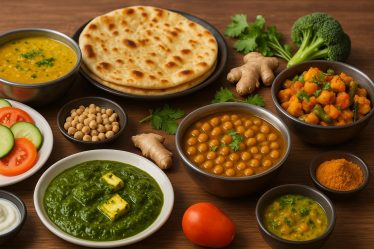
Dal, sabzi, rice, roti. These four elements, combined in countless variations across India’s 28 states, form complete nutritional profiles without meat. Indian cooks mastered the art of layering flavor through spice rather than fat. They built richness through slow cooking. They created depth through fermentation and through the intelligent use of aromatics.
The variety within this tradition is extraordinary. The recipes gathered under vegan Indian meals reflect just how developed this plant-based heritage truly is, ranging from the coconut-rich curries of Kerala to the mustard-spiked greens of Bengal, from the lentil feasts of the Punjab to the tamarind-driven rasam of Tamil Nadu.
This tradition connects India to the plant-based heritage of East and Southeast Asia. Buddhist culinary traditions across China, Japan, Korea, and Vietnam developed sophisticated vegetarian cooking for similar reasons. The overlap in technique is striking. Both traditions use slow cooking to extract depth. Both use fermented condiments to add complexity. Both treat vegetables as the primary subject of the meal, not a side note.
How Regional Comparisons Reveal Deep Connections
One of the clearest ways to understand Indian food’s place in the wider Asian culinary world is to place it alongside its neighbors. The similarities are not surface level. They run through technique, ingredient logic, and kitchen philosophy.
Studying Asian cooking styles across different regions reveals how these techniques evolved in parallel, each shaped by local ingredients but driven by the same practical and sensory goals. The shared patterns are hard to ignore once you start looking.
Here are five techniques that Indian cooking shares with other Asian food traditions:
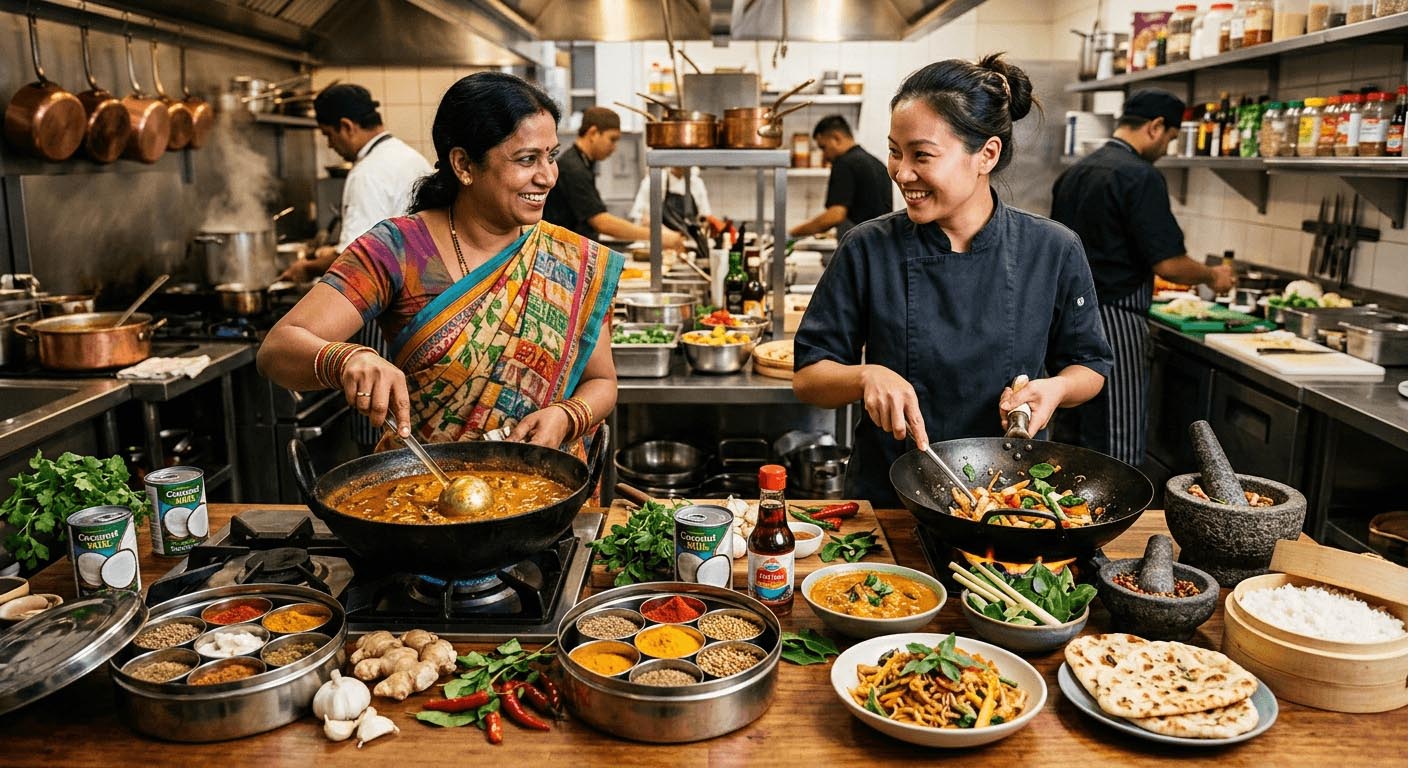
- Tempering spices in hot oil or ghee (the Indian tadka) mirrors the Chinese practice of blooming aromatics in a wok before building a dish.
- Slow-cooking legumes and proteins until they absorb surrounding flavors is a cornerstone of both Indian dal-making and Japanese nimono, the tradition of simmered dishes.
- Using rice as a base that carries other flavors, rather than as a standalone starch, is fundamental in Indian, Chinese, Japanese, Thai, and Vietnamese kitchens alike.
- Balancing heat, sweetness, sourness, and salt in a single dish is a shared goal across Indian, Thai, and Vietnamese cooking, with each cuisine arriving at its own precise balance.
- Cooking in sealed or clay vessels to retain moisture and concentrate flavor appears in Indian dum cooking and Chinese clay pot cooking in ways that suggest parallel invention rooted in the same intuition.
Communal Rituals That Bind Asian Kitchens Together
Food in India has never been a solitary act. Cooking for others is an expression of love, respect, and community. This attitude is shared across Asia in ways that reflect something much deeper than cultural coincidence.
The Indian concept of prasad, food offered first to the divine and then shared with the community, has parallels in Japanese food offerings at shrines and in Chinese ancestral altar cooking. Across cultures, food prepared with intention for a group carries a different weight than food made for one.
Festival cooking is another shared thread. Consider:
- Diwali sweets made in family kitchens in large batches, passed between neighbors as gifts
- Lunar New Year dumplings folded together by multiple generations at a single table
- Eid biryanis cooked in vast pots that feed entire neighborhoods
- Japanese osechi ryori, prepared days in advance to honor the new year with layered meaning in each dish
- Korean jesa, ancestral memorial food prepared with precision and shared after the ceremony
In each of these traditions, the act of cooking together is the ritual, not just the eating. The kitchen becomes a place where memory is made, stories are told, and identity is passed down.
There is also a shared ethic of hospitality through food. In India, a guest is never left unfed. The same principle runs through Japanese omotenashi, Chinese hosting customs, and the generous table culture found across South and West Asia. Food is how you say welcome, and that message is consistent across the continent.
The Diaspora and the Traveling Kitchen
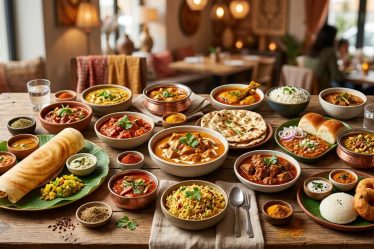
The Indian diaspora has carried these culinary traditions across the globe with remarkable care and creativity. In Singapore, Malaysia, Fiji, Trinidad, Kenya, the United Kingdom, and the United States, Indian communities rebuilt their kitchens in new environments. They adapted to local ingredients while preserving the core of what they cook.
This process of adaptation is not dilution. It is exactly what has been happening across Asian food cultures for thousands of years. A spice finds a new home. A technique meets a new ingredient. Something new is created, but the roots remain visible.
“Cuisine is one of the most portable and enduring forms of cultural identity. Every dish prepared in a diaspora kitchen carries the memory of a homeland and the creativity of a new place.”
Colors of India captures this ongoing story with depth and warmth, documenting how Indian food traditions travel, adapt, and continue to carry cultural meaning for diaspora communities worldwide. It is a publication built around the understanding that food is not just sustenance. It is identity, memory, and belonging cooked into the same pot.
The reach of Indian culinary influence in Southeast Asia alone tells a significant story. Indian traders and laborers who settled in Malaysia, Singapore, and Indonesia centuries ago brought their cooking with them. The result is a living archive of culinary crossover: roti canai in Kuala Lumpur, curry puffs in Singapore, the Indian-influenced spice pastes of Indonesian cooking. These foods are now claimed as local, because they are. That is how culture works.
One Continent, One Conversation, Still Cooking
Indian food belongs to India. Its regional variations, its philosophical depth, its thousand-year-old techniques are distinctly and proudly South Asian. Nothing about tracing its connections to wider Asian culinary tradition takes anything away from that.
What these connections do is add context. They show that Indian cooking did not arrive fully formed from a vacuum. It grew in conversation with the world around it, absorbing influences and sending them outward in equal measure. The spices that defined its flavor profile are the same ones that appear in Thai curries and Chinese braises. The fermentation logic behind idli is the same logic behind kimchi and miso. The plant-based mastery that has fed India for millennia runs parallel to Buddhist vegetarian traditions across East Asia.
Understanding these links makes Indian food richer, not simpler. Every dish carries more history once you know how far its ingredients have traveled and how many kitchens they passed through on the way to your plate. The conversation between Indian cooking and the rest of Asia is still ongoing. It is happening in diaspora kitchens, in markets where ingredients from different traditions share the same shelf, and in the daily act of someone deciding what to cook tonight and reaching, instinctively, for spices that have been crossing borders for thousands of years.